

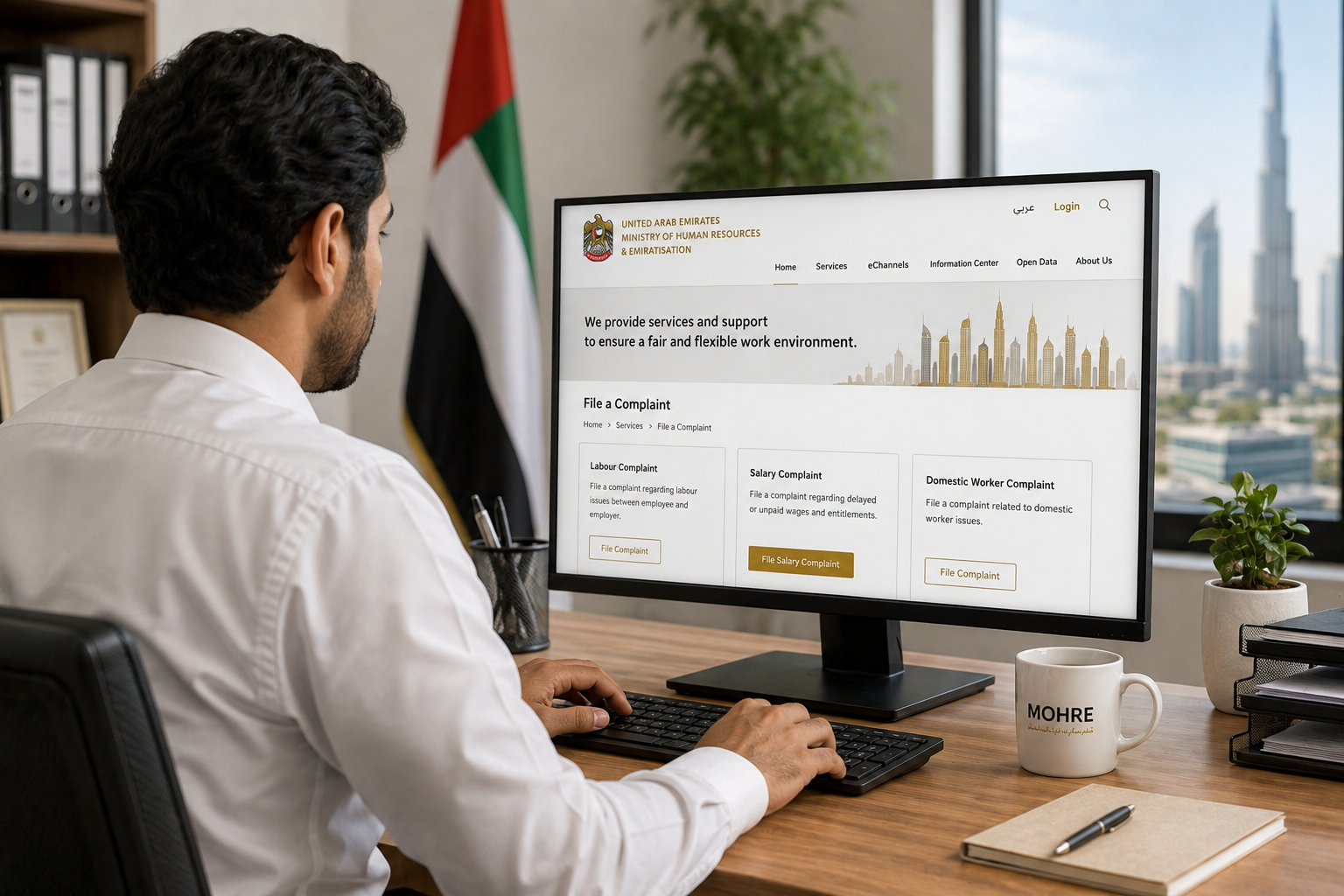
Employees in the UAE private sector have the right to receive their salaries on the agreed payment date. However, wages may sometimes be delayed because of financial problems, payroll errors, company disputes, or an employer’s failure to meet contractual obligations.
The Ministry of Human Resources and Emiratisation (MOHRE) provides complaint services to help eligible private-sector employees report unpaid wages and recover employment entitlements. Choosing the correct complaint process and submitting accurate information are essential for avoiding delays. Experienced Employment Lawyer in UAE can review salary records, calculate outstanding dues, and guide employees through MOHRE proceedings or court action where necessary.
An unpaid or delayed salary arises when an employer fails to pay the wage agreed in the employment contract on its stated due date. The contract should identify the employee’s basic salary, applicable allowances, and payment schedule.
Under current wage-payment rules, an employer is generally considered late if payment has not been made within the first 15 days following the due date, unless the employment contract provides for a shorter period. Employees do not necessarily need to wait for several missed salary cycles before taking action.
A salary issue may include:
Complete non-payment of monthly wages
Payment of only part of the agreed salary
Repeated delays in salary transfers
Unauthorized deductions from basic salary or allowances
Failure to pay salary during an applicable notice period
Outstanding wages after resignation or termination
Not every deduction is unlawful. UAE Labor Law permits deductions in specified circumstances, such as approved loan repayments, court-ordered debts, certain disciplinary penalties, or compensation for proven damage. However, deductions made without a lawful basis may be challenged through MOHRE.
After employment ends, the employer must settle the employee’s unpaid wages and other contractual or statutory entitlements within the legally prescribed period.
The UAE Labor Law requires private-sector employers to pay workers on the agreed due dates and in accordance with the employment contract and applicable MOHRE regulations. Employers cannot withhold salary merely because of an internal disagreement unless a lawful reason permits the deduction.
The amount and type of wage should be stated in the employment contract. Employers must pay the agreed salary on time, including the basic wage and any contractual allowances forming part of the employee’s remuneration.
Federal Decree-Law No. 33 of 2021, as amended, regulates most private-sector employment relationships in the UAE. It establishes employee rights, employer obligations, permitted salary deductions, dispute procedures, and final settlement requirements.
Establishments registered with MOHRE are generally required to transfer employee salaries through the Wage Protection System or another approved system. The system creates an official payment record and helps MOHRE identify delayed, incomplete, or missing wage transfers.
A WPS record can therefore be important when determining whether the employer paid the correct amount on time.
When an employment contract ends, the employer must generally pay outstanding wages and other employment entitlements within 14 days from the contract’s end date. Depending on the circumstances, these dues may include unpaid salary, leave pay, notice-period compensation, overtime, and end-of-service benefits.
MOHRE’s private-sector salary complaint service is primarily available to employees registered in the Ministry’s employment database. This usually includes workers employed by mainland private-sector companies regulated by MOHRE.
Both current and former employees may raise disputes regarding unpaid wages or employment entitlements. A former employee may therefore file a complaint where salary or final dues remain unpaid after resignation, termination, or contract expiry.
For the confidential salary complaint service, the worker must be registered with MOHRE and must not already have another complaint pending or the same dispute before a court.
Different procedures may apply to other employment categories. Domestic workers have a separate MOHRE complaint service governed by domestic worker legislation. Employees of free-zone companies may need to approach the relevant free-zone authority first or follow a separate referral process, depending on the jurisdiction and the authority that issued the work permit.
Employees should confirm the appropriate authority before filing, as submitting the matter through the wrong service may cause unnecessary delays.
MOHRE offers different complaint routes depending on whether the employee wishes to confidentially report delayed wages or formally claim payment and other employment rights.
A confidential salary complaint is designed specifically for employees whose employer has failed to pay wages on time. During the initial process, the complainant’s identity is not disclosed to the employer.
The employee submits personal and employment information through the MOHRE website or mobile application. MOHRE then investigates the complaint. If the allegation appears valid, the matter may be referred to the Labor Inspection Department for a workplace visit and verification.
This option is suitable where the employee wants MOHRE to investigate the salary violation while preserving confidentiality during the initial complaint process. MOHRE currently lists no supporting documents as mandatory at the application stage, although employees should still preserve contracts, bank records, payslips, and communications for possible later use.
The confidential salary complaint service is not generally available where the same employee already has a pending labor complaint or court dispute.
A formal labor complaint is more appropriate when the employee wants to recover unpaid salary, final dues, leave pay, notice compensation, or other contractual entitlements.
In this process, MOHRE reviews the claim and contacts both the employee and the employer. The Ministry initially attempts to resolve the dispute amicably based on the employment contract, payment records, supporting evidence, and statements provided by both parties.
Evidence may include:
Employment contracts and job offers
Bank statements and salary-transfer records
Payslips and WPS information
Emails, messages, and written payment requests
Resignation or termination documents
Calculations of the unpaid amount
If the parties cannot reach a settlement, MOHRE may issue a decision where legally authorized or refer the dispute to the competent court. The correct procedure will depend on the claim amount, nature of the dispute, and applicable legal provisions.
Proper documentation helps MOHRE understand the complaint, verify the employment relationship, and calculate the amount owed. Although every document may not be mandatory when the complaint is first submitted, employees should prepare as much supporting evidence as possible.
Useful documents include:
Emirates ID and passport details: These confirm the employee’s identity and immigration records.
Employment contract or job offer: The MOHRE contract helps establish the agreed basic salary, allowances, job title, and payment terms.
Bank statements: Salary transfer records can show missed payments, delays, or amounts lower than the agreed wage.
Payslips and WPS records: These may help confirm what the employer reported or transferred through the Wage Protection System.
Written communications: Emails, messages, or letters requesting payment can demonstrate that the employer was informed about the unpaid salary.
Employment-ending documents: Resignation letters, termination notices, work permit records, or cancellation documents may be relevant when final dues remain unpaid.
Claim calculation: Employees should prepare a clear breakdown of unpaid salary, allowances, leave pay, notice pay, overtime, gratuity, or other claimed entitlements.
All dates, amounts, and employment details should be checked carefully before submission. Inconsistent calculations or incomplete records may delay the complaint.
Before filing, review the employment contract, bank statements, payslips, and payment history. Identify the months for which salary remains unpaid and calculate the total amount outstanding.
The calculation should separate each entitlement, such as:
Unpaid monthly salary
Contractual allowances
Unlawful deductions
Notice-period pay
Accrued leave salary
End-of-service benefits
A clear calculation helps reduce disagreement over the amount being claimed.
Employees should choose the complaint route that matches their objective.
A confidential salary complaint is suitable when the employee wants to report an employer’s failure to pay wages on time without initially disclosing the complainant’s identity. MOHRE investigates the report and may refer it for inspection.
A formal labor complaint is more appropriate when the employee wants to recover unpaid salary or claim other employment rights. In this process, MOHRE contacts both parties and attempts to resolve the dispute.
Selecting the correct service is important because the confidential complaint process is mainly designed to report salary violations, while a formal complaint is used to pursue payment and other legal entitlements.
The complaint may be submitted through the MOHRE website or mobile application. The applicant must enter the required personal and employment information, including passport details, Emirates ID information, nationality, and relevant establishment details.
After entering the information, the applicant may receive an OTP by text message or email to verify their identity and confirm the application. Supporting documents can then be submitted where required or relevant to the claim.
Employees should ensure that their registered telephone number and email address are active so they do not miss verification messages or case updates.
Once the complaint is registered, the employee should keep the reference or transaction number. This number can be used to follow the case through MOHRE’s application-status and inquiry services.
MOHRE normally communicates updates through text messages, email, telephone calls, or the smart application. Employees should respond promptly to requests for documents, clarification, or attendance at a scheduled meeting. Failure to respond may delay the complaint or affect its progress.
After receiving a formal labor complaint, the competent MOHRE officer reviews the information and supporting documents. The officer may contact the employee and employer to obtain their statements and clarify the disputed amounts.
MOHRE first attempts to resolve the matter through an amicable settlement. The parties may be contacted more than once, and a meeting may be scheduled if the issue cannot be resolved through the initial discussions.
For a confidential salary complaint, MOHRE investigates whether the employer has failed to pay wages on time. Where the complaint appears valid, the matter may be referred to the Labor Inspection Department for a visit to the establishment.
Depending on the type and value of the dispute, the process may result in:
Payment through an agreed settlement
Cancellation of the work permit where relevant
A final decision issued by MOHRE
Referral of the dispute to the competent court
Any settlement should clearly state the amount being paid, the payment date, and the claims being resolved. Employees should read the terms carefully before accepting or signing an agreement.
MOHRE currently lists a standard service-completion period of 14 working days for private-sector labor complaints and confidential salary complaints. This period generally covers the Ministry’s review and attempted resolution process.
However, the overall matter may take longer where:
The employer cannot be contacted
The parties dispute the salary amount
Additional evidence is required
Several employment entitlements are included
Settlement meetings are postponed
The dispute must be referred to court
The 14-working-day service period should therefore not be treated as a guarantee that the employee will receive payment within that time. It relates to the MOHRE complaint process, while court proceedings and enforcement may require additional time.
Employees should also avoid delaying legal action. Under the current UAE Labor Law, a legal claim concerning an employment right may generally not be heard after one year from the date on which that right became due. The exact calculation can depend on the nature and maturity date of each claimed entitlement, so timely legal advice is important.
MOHRE has authority to issue a final decision in an individual labor dispute where the claim value does not exceed AED 50,000. The Ministry may also decide disputes involving a party’s failure to comply with an amicable settlement previously reached through MOHRE, regardless of the amount involved.
A qualifying MOHRE decision is issued with enforceable status, allowing the successful party to take the required execution steps. However, either party may challenge the decision by filing a case before the competent Court of Appeal within 15 working days from notification of the decision.
Filing the challenge suspends enforcement of the MOHRE decision while the court reviews the matter. Under the applicable legal framework, the Court of Appeal schedules the matter promptly, and its judgment is final.
Where the claim exceeds AED 50,000 and no amicable settlement is reached, MOHRE generally refers the dispute to the competent court with a memorandum summarising the dispute, the parties’ positions, and the Ministry’s recommendations.
Because court referral and appeal procedures involve strict deadlines and legal submissions, employees may benefit from consulting experienced UAE Lawyers before accepting a settlement, challenging a decision, or pursuing the claim before the courts.
An employee may claim unpaid salary and other employment entitlements arising from the employment contract and UAE Labor Law. The amount recoverable depends on the employee’s records, contract terms, length of service, and circumstances surrounding the end of employment.
A salary-related claim may include:
Unpaid Basic Salary and Allowances: Employees may claim monthly wages and contractual allowances that became due but were not paid.
Wrongful Salary Deductions: Deductions that do not fall within legally permitted categories may be disputed through MOHRE.
Unpaid Overtime: Overtime compensation may be claimed where the employee can show that additional hours were worked and that payment was legally due. Attendance records, schedules, emails, and manager instructions may support the claim.
Notice-Period Salary: Where an employer ends the contract without providing the required notice, the employee may be entitled to compensation for the full notice period or its remaining portion.
Accrued Leave Salary: An employee whose employment ends before using accrued annual leave may claim payment for eligible unused leave days, generally calculated according to the applicable legal rules.
End-of-Service Benefits: Eligible employees may claim gratuity or benefits due under an approved alternative savings scheme. Other final entitlements may include outstanding commissions, contractual bonuses, reimbursable expenses, or compensation arising from unlawful termination.
Each part of the claim should be calculated separately and supported by employment records. Claiming unsupported amounts may make settlement more difficult.
An employer should not dismiss a worker because the worker has filed a serious complaint with MOHRE or brought a valid legal claim against the employer. Where the complaint or lawsuit is proven valid, and the dismissal occurred because of that action, the termination may be treated as unlawful.
However, filing a complaint does not prevent an employer from terminating employment for a separate lawful reason. A termination may still be valid if it is based on genuine business requirements, contract expiry, employee misconduct, poor performance supported by records, or another legally permitted ground.
Employees who believe they have faced retaliation should preserve evidence such as:
The MOHRE complaint reference and filing date
Termination letters and warning notices
Emails, messages, or verbal threats confirmed in writing
Performance reviews and attendance records
Evidence showing the timing between the complaint and dismissal
Statements from colleagues who witnessed relevant discussions
If unlawful termination is established, the competent court may award fair compensation based on the nature of the work, the harm suffered, and the employee’s period of service. Such compensation is separate from any notice-period allowance, unpaid wages, or end-of-service benefits that may also be due.
Employees should avoid errors that can delay their complaint or weaken the supporting evidence.
Waiting Too Long: Delaying action may make documents harder to obtain and could cause the employee to miss the applicable legal limitation period.
Providing No Clear Calculation: The claim should identify each unpaid month and separately calculate salary, allowances, overtime, leave pay, notice compensation, and other benefits.
Failing to Preserve Evidence: Bank statements, employment contracts, payslips, attendance records, emails, messages, and payment requests should be saved before access to company systems is removed.
Choosing the Wrong Service: A confidential salary complaint is intended to report delayed wages, while a formal labor complaint is generally more suitable for recovering salary and other financial entitlements.
Missing MOHRE Meetings or Deadlines: Employees should respond promptly to MOHRE calls, attend scheduled meetings, and monitor all appeal or court-referral deadlines.
Signing an Unclear Settlement: A settlement may limit further claims. Employees should confirm the amount, payment deadline, claims covered, and consequences of accepting it before signing.
Salary disputes may involve several entitlements, disputed calculations, termination issues, and strict procedural deadlines. Experienced UAE Lawyers can assess the employment relationship and help determine the most appropriate complaint route.
Legal assistance may include reviewing the employment contract, job offer, salary records, bank statements, and termination documents. Lawyers can calculate unpaid wages, overtime, leave salary, notice compensation, end-of-service benefits, and any potential unlawful-termination claim.
They may also help organize evidence, prepare written submissions, and assist during MOHRE settlement discussions. Where a decision must be challenged, or the dispute is referred to court, legal professionals can prepare the case and represent the employee before the relevant judicial authority.
Employers may also seek legal advice to review payroll practices, permitted deductions, Wage Protection System compliance, and internal complaint procedures. Early compliance advice can help prevent salary disputes and reduce the risk of penalties or litigation.
Experienced professionals at UAE Lawyers can examine the facts, identify the correct MOHRE procedure, and provide guidance tailored to the value and complexity of the unpaid salary claim.
Employees in the UAE private sector have the right to receive their agreed salary on time. When an employer delays or withholds wages, the employee may use MOHRE’s complaint procedures to report the violation and seek recovery of unpaid employment entitlements.
A successful claim depends on selecting the correct complaint service, preparing an accurate calculation, preserving supporting evidence, and acting within the applicable legal deadlines. Employees should also carefully review any proposed settlement before accepting it.
For complicated disputes involving unpaid wages, final benefits, unlawful deductions, or retaliatory termination, consult experienced UAE Lawyers. Professional legal support can help protect your rights and guide the case through MOHRE proceedings, settlement negotiations, and court action where required.





At UAE Lawyers, we are more than just a legal practice - we are a team of dedicated professionals driven by the core values of justice, integrity, and compassion.